

Sparks (credit system)
How Sparkian’s credit-based pricing works.
Every Sparkian account runs on Sparks. It is a credit balance that gets deducted with every message you send, instead of billing you by raw token count. This keeps usage predictable, since the cost of a request depends on the model and content you use rather than an opaque per-token rate.
The estimated Spark cost for each model is shown live on that model’s detail panel inside Sparkian, so you have a good idea of the price before you send a message.
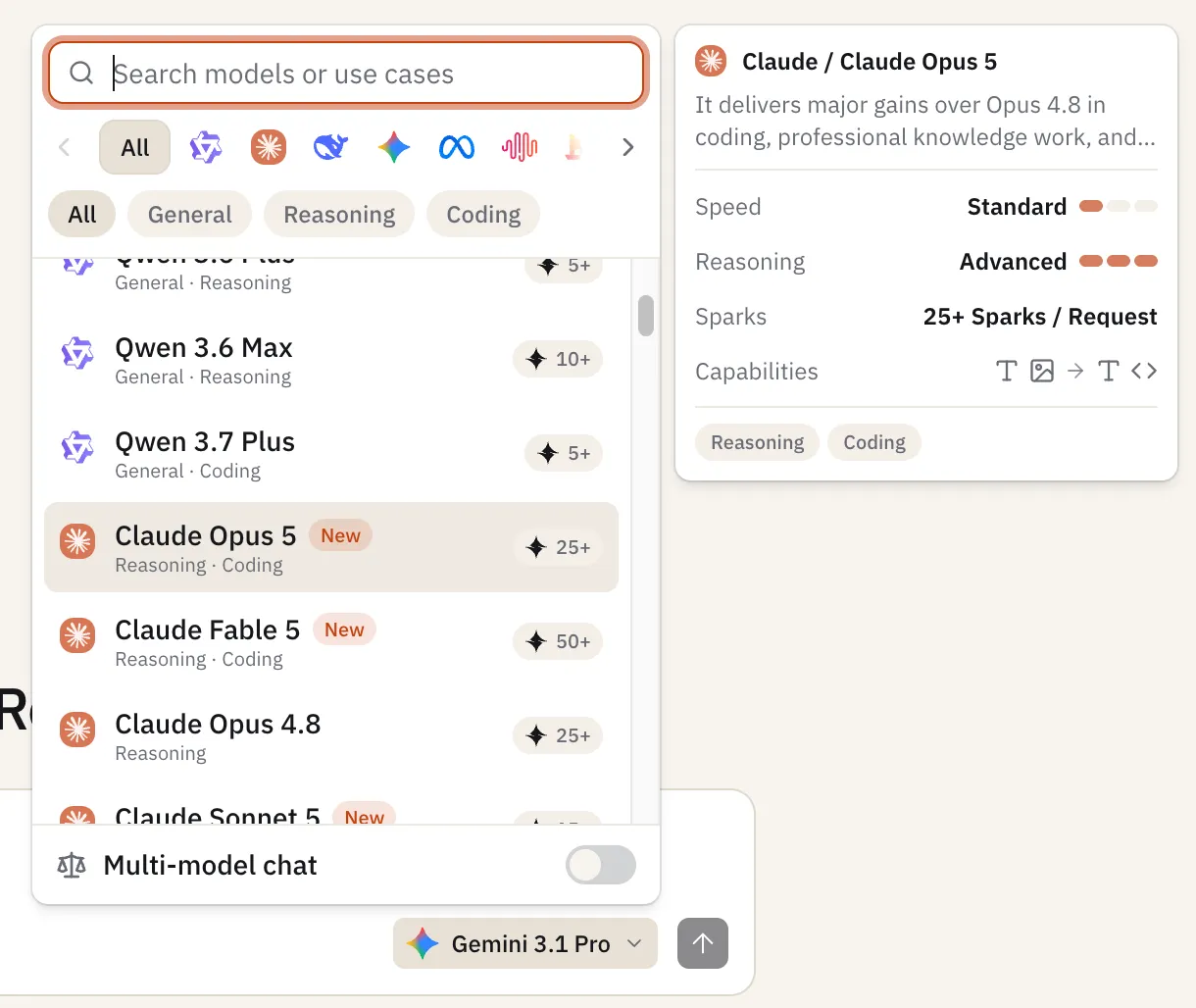
How Sparks are estimated
Each model’s detail panel shows a starting cost, like “1+ Sparks / Request” or “25+ Sparks / Request”. The + means this is an estimate, not a fixed price. Sparkian calculates your actual Spark cost based on real usage for that request, not a flat rate per model.
Examples from the model picker:
- Qwen 3.5 Flash (a Lite, general-purpose model) → 1+ Sparks / Request
- Claude Opus 5 (an Advanced, reasoning/coding model) → 25+ Sparks / Request
See what each message cost
Every response shows the Sparks it consumed: hover the ✦ icon in the response’s action row. For a bigger picture, Analytics breaks down Sparks spent over time, by chat, and by model.
Why your actual cost can be higher than the estimate
The final Spark cost scales with how much your request actually processes like your message, the AI’s response, any retained chat history, and attachments, all combined. A short, simple message will land close to the model’s listed estimate; a request with a long conversation history or large attachments will cost more, since there’s more for the model to read and respond to.
Plans and model access
Your Sparks come from your plan’s monthly allowance, topped up by any one-time purchases. Some models are also plan-gated — the model picker marks these Sign in or Locked rather than showing a Spark estimate. See Plans for details.
Tips to reduce Spark usage
- Start a fresh chat when switching topics. Older messages in chat history count toward your token total.
- Pick the lightest model tier that can handle the task.
- Upload files you reuse often to your Knowledge base instead of re-attaching them to every message.
- Combine related questions into a single message rather than sending several small ones.